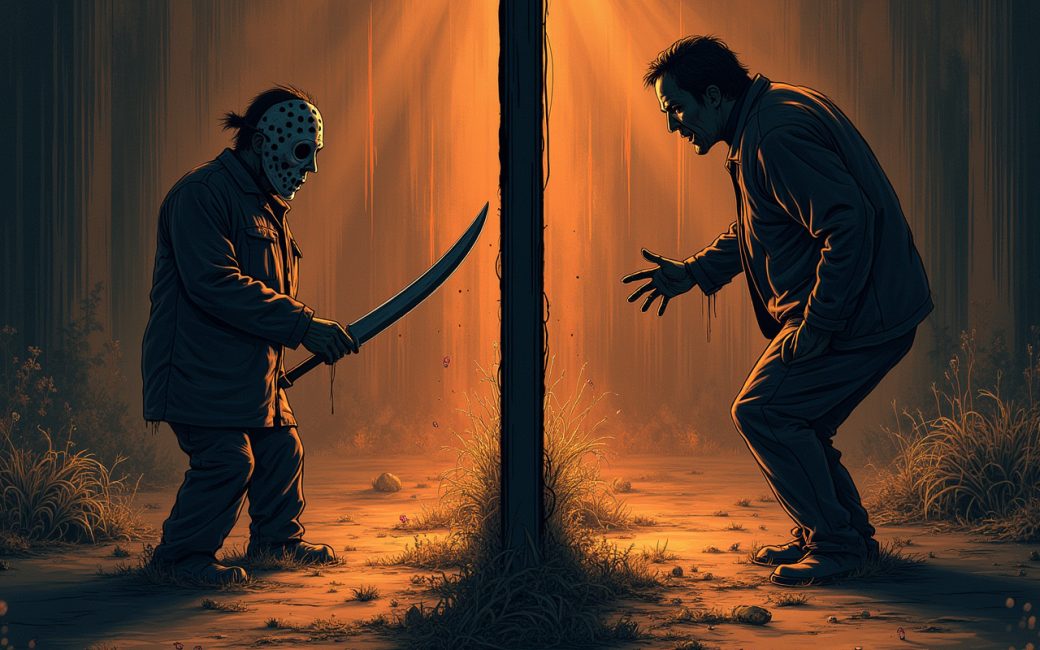
Reader wants 'a good scare' for a specific night
The first decision is not which movie is "best" — it's whether tonight calls for jolts or dread. A jump-heavy slasher and a slow-burn possession film both sit under "horror," but they produce almost opposite physical responses, and picking the wrong one for the mood in the room is the most common reason a horror pick falls flat.
Start by naming what's actually wanted:
- Jolts (a "scare") — short, sharp startle responses, usually delivered by sound cues and sudden reveals. This is the territory of slashers and monster movies, and it's explicitly how Netflix frames its own horror rundown, built around "when you want a good scare."
- Sustained dread (a "fear") — a mood that builds across the runtime rather than spiking in individual moments. This is the register of possession stories and slow-burn psychological work, closer to what Paramount+'s list of psychological thrillers is organized around.
Once you know which of those two a viewer means, match it to a subgenre — slasher or monster movie for jolts, possession or slow-burn thriller for dread — and then check that a specific title in that subgenre is actually on a service you can open right now, rather than working from a decades-spanning canon that mixes eras and availability together. A list spanning a century of releases is not a Tuesday-night answer; a single title on a platform you already pay for is.
Reader asks 'what is the No. 1 best horror movie?'

There is no single No. 1 — the answer changes depending on which ranking method is being used, and none of the major sources state their method the same way. Before trusting a number, it helps to know which of three approaches produced it.
| Ranking method | How the number one is decided | Example source |
|---|---|---|
| Aggregate critic score | Average of many critics' reviews, tallied by a review-aggregation site | Rotten Tomatoes' 200 Best Horror Movies |
| Single-outlet editorial pick | One publication's staff or contributing critics vote or rank by consensus | Empire's 50 Best Horror Movies |
| Platform curation | A streaming service's own editorial team, organized around mood or occasion rather than score | Netflix's horror-movie rundown |
A film can sit near the top of an aggregate-score list because it has almost no negative reviews, while a single-outlet list ranks a different film first because that outlet's editors weigh influence or scares over polish. Neither is wrong; they're answering different questions. The practical move is to pick the method that matches what you actually value — consensus, one outlet's taste, or a mood-based curation — and take that source's number one, rather than treating any single "No. 1" as settled fact.
Reader is choosing for a group with mixed tolerance
The failure mode in a group watch is one person tapping out partway through, and the fix is to screen for intensity before you screen for quality. Three things to check ahead of pressing play:
- Gore level — is violence shown on-screen or implied off-screen, and how frequently.
- Animal or child harm — a specific trigger for many viewers that general "scary" labels don't flag.
- Sustained dread versus jump density — a film that's quiet for eighty minutes and then relentless for ten plays very differently in a group than one that startles every few minutes throughout.
These details aren't stated as part of a title's entry on most curated rundowns, so they have to be worked out separately — usually from a plot summary plus a memory of the film's reputation, not from the placement in a list. As a rule of thumb, monster movies and vampire films tend to sit lower on graphic-content intensity than extreme slasher entries, because the threat is often kept at a visual distance for a large part of the runtime; that makes them a safer default for a mixed-tolerance room than a title built entirely around close-up violence. Whatever you land on, confirm it's actually reachable on a service everyone in the group can open — a title that requires a rental nobody wants to pay for is not a real pick.
Reader wants to enter a franchise
Entering a long-running horror franchise raises a question that a title-by-title list never answers, because entries usually get discussed individually rather than in sequence: do you start with the original, or with the best-reviewed entry, and does it matter?
- Identify which is which. The first film in a franchise and the most acclaimed film in it are often different movies — a franchise can build to its best-reviewed entry several instalments in, after the format has been refined.
- Check whether sequels need the original for plot, or just for tone. Some horror franchises are tightly serialized, where skipping the first film means missing character and mythology setup. Others are anthology-style, where each entry is a self-contained story and only the register or "vibe" carries over.
- Watch in the order that matches your actual goal. If the goal is understanding the mythology, start at the beginning. If the goal is simply experiencing the strongest film the series has to offer, it's reasonable to start there and treat everything else as optional.
This is a sequencing decision, not a quality decision, and it's worth making before picking any single title, since franchise entries so often get placed side by side with standalone films as if watch order were irrelevant.
Director
Horror recommendations are usually organized around the director's name as the primary fact attached to each entry — it's the detail used to tell one haunted-house movie apart from another, and it's the shorthand for the specific fears a given filmmaker returns to across a career. A director who repeatedly stages threats inside domestic space is doing something different from one who returns again and again to body horror or to isolation in wilderness settings, and that recurring preoccupation is often a more useful way to predict whether you'll respond to a film than its subgenre label alone. When a title is credited to a director, it's worth reading that credit as pointing to a pattern across that director's other work, not just as an attribution for the one film in front of you.
Horror film
"Horror" as a single genre label is broad enough to be nearly useless on its own — it covers everything from slow-burn psychological studies to gore-forward slashers to creature features, and it functions as an umbrella term while the actual organizing work happens one level down. Rotten Tomatoes' 200-title guide, for instance, spans nearly a century of releases under that one heading. Treat "horror film" as the category you start from, not the level of detail you make a decision at — the useful distinctions live in subgenre and in intensity.
Ranked best-of list
The dominant format for horror recommendation is the numbered rundown — anywhere from two dozen to two hundred titles, ordered top to bottom with a number attached to each. That format is good at establishing a canon and bad at answering a specific viewing question, because a number position tells you almost nothing about tone, intensity, or availability. A title ranked 40th on an aggregate list might be the exact right pick for tonight's mood, while the film ranked 1st might be wrong for the room. Use a rundown like this as a pool of titles to draw from, and make the actual selection using mood, tolerance, and access — not rank order.
Critic vs audience ranking
Horror rankings are typically built from one of three underlying sources, and knowing which one you're looking at changes how much weight to put on the order:
- Aggregate critic score, where the ranking reflects how consistently reviewers responded well across a large sample, as with Rotten Tomatoes' guide.
- Single-outlet editorial consensus, where one publication's staff has ranked titles by its own internal taste, as with Empire's list.
- Individual or platform curation, where the order reflects one curator's or one service's taste rather than a broad sample, as with a streaming platform's mood-based rundown.
None of these is more "correct" than another — they're measuring different things. A critic-aggregate ranking rewards consistency of critical approval; a single-outlet list rewards that outlet's editorial taste; a curated list rewards fit with a stated mood or occasion. Matching the method to what you actually want from the recommendation is more useful than treating any one number as definitive.
Subgenre
Subgenre is the axis that actually predicts whether a viewer will enjoy a specific film, more reliably than the "horror" label or even the director credit alone. The recurring subgenre labels across horror coverage are zombie films, vampire films, and monster movies more broadly, alongside slasher, possession, and slow-burn psychological work. Each of these carries its own default intensity profile and pacing — zombie films tend toward sustained group-threat tension, vampire films toward a mix of atmosphere and set-piece violence, monster movies toward a slower reveal of the threat itself. Sorting by subgenre before sorting by quality gets you to a workable shortlist much faster than scanning a hundred-plus titles by rank alone.
Zombie film
Zombie films are one of the most consistently represented subgenres in horror recommendation, appearing throughout sources like Rotten Tomatoes' 200 Best Horror Movies and Netflix's genre rundown. The subgenre's defining fear is less about a single startling figure than about an overwhelming, spreading threat and the breakdown of group cooperation under siege — which tends to make zombie films read as tense rather than shocking moment to moment, a useful distinction for a viewer who wants sustained pressure without frequent jump-scare spikes.
Because the threat in a zombie film is usually collective rather than singular, these titles also tend to run long on set pieces involving groups of survivors, which is worth knowing if what you actually want is a tight, contained scare rather than an ensemble siege narrative. If the appeal is claustrophobia and a small cast, a zombie film may not be the closest match even when it's labelled correctly as horror.
Vampire film
Vampire films sit alongside zombie films as one of the most frequently recurring subgenre labels in horror coverage, including Empire's ranking. The vampire subgenre typically blends supernatural threat with an atmosphere-first approach — mood, setting, and slow-building menace often carry more weight than sudden shocks — which is part of why vampire titles are often a lower-intensity choice for a mixed-tolerance group than a comparably ranked slasher entry, without necessarily being a lesser film by any critical measure.
Vampire stories also vary more than most subgenres in tone across individual titles: some lean gothic and romantic, others lean toward body horror or violence closer to a slasher's register. That range means the subgenre label alone tells you less about intensity than it does for, say, a straightforward zombie siege film, and it's worth checking a specific title's reputation rather than assuming "vampire film" means one fixed thing.
What is the scariest thriller movie ever?
There is no single agreed-upon answer, because "scariest" measures a physical fear response while most rankings measure critical or audience quality — and those are not the same ranking. A film widely cited near the top of a critic-aggregate list, such as the titles compiled in Rotten Tomatoes' 200-film guide, earned that position through consistency of critical approval across decades of reviews, not through a measured fear response.
If the actual question is which film delivers the most jump-scare-driven intensity, a more useful source is a rundown explicitly built around that promise, like Netflix's list of horror movies for when you want a good scare, or a psychological-thriller-specific list such as Paramount+'s rundown of films built to unsettle if what's wanted is dread rather than jolts. A shorter, more curated list such as the University of Western Ontario's five picks for horror and thriller viewing is built around a different goal again — a manageable starting point for someone without a long history of watching the genre — rather than an attempt to crown a single scariest film.
Treat "scariest" and "best" as two separate questions with two separate answers, and pick the source that was actually built to answer the one you're asking.
Pick the subgenre that matches tonight's mood, confirm the title is on a service you can open, and press play.